WordPress powers more than 40% of all websites on the internet, yet it’s still surrounded by confusion and misconceptions. Many businesses avoid or misuse WordPress because of outdated myths that are no longer true.
In this blog, we’ll break down the most common WordPress myths and explain the real truth behind them—so you can make informed decisions for your website.
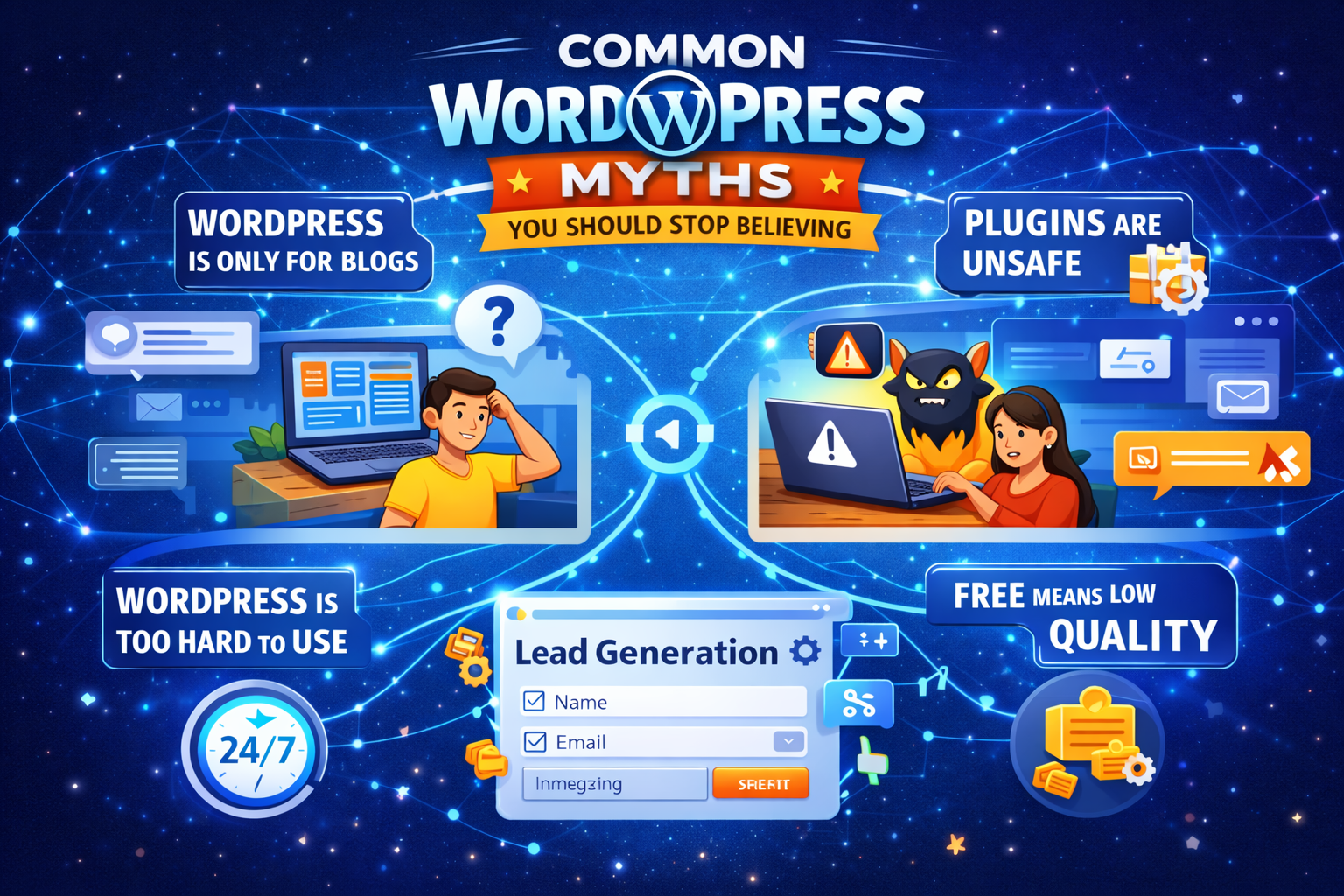
Myth 1: WordPress Is Only for Blogs
The myth:
WordPress is just a blogging platform and not suitable for serious websites.
The truth:
WordPress started as a blogging tool, but today it’s a full-featured Content Management System (CMS). You can build:
- Business websites
- eCommerce stores (WooCommerce)
- Membership sites
- Online learning platforms
- Directories and marketplaces
- Enterprise-level websites
Major brands, startups, and government sites all use WordPress successfully.
Myth 2: WordPress Is Not Secure
The myth:
WordPress websites get hacked easily.The myth:
The truth:
WordPress itself is secure by default. Most security issues happen due to:
- Outdated themes or plugins
- Weak passwords
- Poor hosting
- Lack of basic security practices
With regular updates, good hosting, security plugins, backups, and proper access control, WordPress can be extremely secure—even for large businesses.
Myth 3: WordPress Websites Are Slow
The myth:
WordPress sites are slow and perform badly.
The truth:
Speed depends on how WordPress is built, not on WordPress itself. Performance issues usually come from:
- Heavy themes
- Too many poorly coded plugins
- Cheap hosting
- Unoptimized images
A well-optimized WordPress site can load in under 2 seconds and score high on Core Web Vitals.
Myth 4: WordPress Can’t Handle Large or Scalable Projects
The myth:
WordPress is only good for small websites.
The truth:
WordPress is highly scalable. It can handle:
- Large traffic volumes
- Thousands of pages or products
- Complex databases
- Multi-site networks
With the right architecture, caching, and hosting, WordPress can grow alongside your business.
Myth 5: You Need to Know Coding to Use WordPress
The myth:
WordPress requires technical or coding knowledge.
The truth:
WordPress is designed for non-technical users. You can manage content, pages, images, and products without coding.
At the same time, developers can fully customize WordPress using PHP, JavaScript, APIs, and custom plugins—making it flexible for both beginners and professionals.
Myth 6: Too Many Plugins Always Break Your Site
The myth:
Using many plugins will automatically slow down or break WordPress.
The truth:
It’s not about how many plugins, but which plugins you use.
- One poorly coded plugin can cause more issues than ten good ones
- Reputable, updated plugins are safe and efficient
- Plugins extend functionality without reinventing the wheel
Quality matters more than quantity.
Myth 7: WordPress Is Bad for SEO
The myth:
WordPress doesn’t rank well on Google.
The truth:
WordPress is one of the most SEO-friendly platforms available. It supports:
- Clean URLs
- Custom meta titles & descriptions
- Schema markup
- Fast loading pages
- SEO plugins like Rank Math or Yoast
Many top-ranking websites run on WordPress.
Myth 8: WordPress Looks Unprofessional
The myth:
WordPress websites look generic or amateur.
The truth:
WordPress design quality depends on design and development, not the platform. With custom themes, modern page builders, and proper UX design, WordPress websites can look just as professional as any custom-built site.
Myth 9: WordPress Is Free, So It Must Be Limited
The myth:
Because WordPress is free, it’s not powerful.
The truth:
WordPress is open-source, not cheap or limited. Its flexibility comes from:
- A massive global developer community
- Thousands of high-quality plugins
- Thousands of high-quality plugins
Continuous improvements and innovation
Myth 10: WordPress Is Becoming Obsolete
The myth:
WordPress is outdated and losing relevance.
The truth:
WordPress continues to evolve with:
- Block editor (Gutenberg)
- Performance improvements
- Headless WordPress support
- Headless WordPress support
- AI and automation integrations
WordPress is very much part of the future of the web.
Final Thoughts
Believing outdated WordPress myths can stop you from using one of the most powerful and flexible platforms available today.
The truth is simple:
- WordPress is secure
- WordPress is scalable
- WordPress is fast (when done right)
- WordPress is SEO-friendly
- WordPress works for beginners and enterprises alike
If you’re using WordPress correctly—or planning to—it can support your website for years to come.
At Trend Web Technologies, we help businesses build secure, scalable, and high-performing WordPress websites—without myths, confusion, or compromises.